HEALTHY AGING AFTER 50
Balance After 50: Your Eyes May Be Doing More Than You Realize
Have you ever felt perfectly steady walking through your home, but less confident on grass, stairs, or in dim lighting?
Your balance may not have suddenly become worse. The information your brain uses to keep you upright may simply have changed.
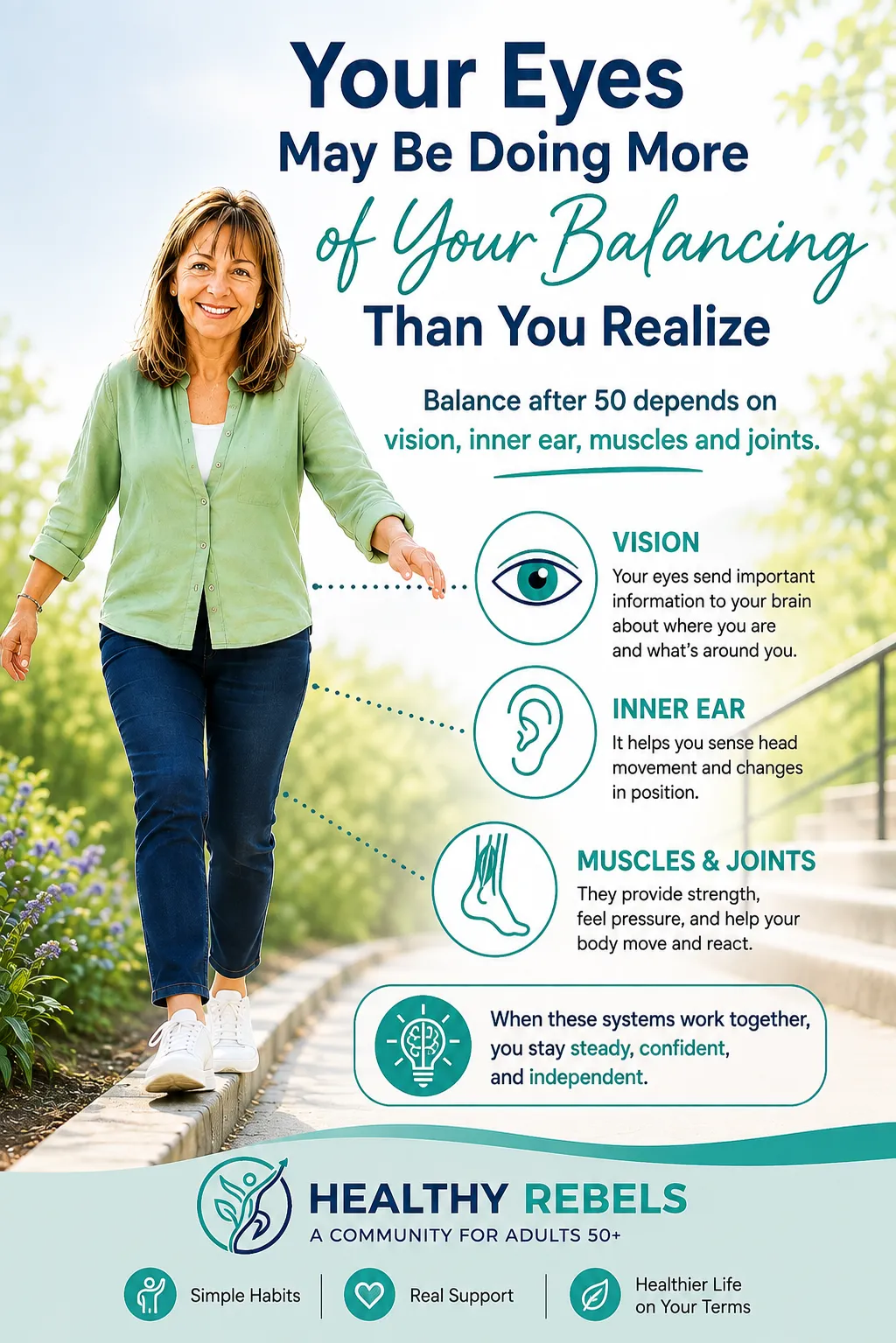
Balance isn't controlled by one part of your body. Your brain continuously combines information from your eyes, inner ear, muscles,
joints, and feet to understand where you are and what your body needs to do next.
Balance Is a Team Effort
Most people think of balance as something you either have or you don't. You stand on one leg, walk a straight line, or climb stairs—and if you wobble, you may assume your balance is getting worse.
But balance isn't one ability controlled by one part of your body.
Your brain is constantly collecting information from three important sources: your eyes, your inner ear, and sensory receptors in your feet, muscles and joints. It compares those signals moment by moment and makes tiny adjustments to help keep you upright.
That's why you might feel perfectly steady walking across a well-lit kitchen floor but suddenly feel less confident stepping onto grass at dusk.
Your balance didn't disappear. The information available to your brain changed.
The Three Systems That Help Keep You Steady
Your brain is constantly cross-checking information from three different sources. Each one tells your brain something different about where you are and how your body is moving.
When one source becomes less reliable — because the lighting changes, the surface becomes uneven, or your head starts moving—the other systems may have to work harder.
1. Your Eyes: Your Visual Reference Point
Your eyes provide your brain with powerful information about your surroundings.
They help you determine where the floor is, how far away a curb may be, where the next stair begins, whether a surface is level, and whether you— or something around you — is moving.
In a well-lit, familiar environment, vision can provide an enormous amount of information about your position in space.
That's one reason balance can suddenly feel different when the lighting becomes poor or familiar visual reference points disappear.
2. Your Inner Ear: Detecting Movement
Inside your inner ear is the vestibular system, which helps your brain detect movement and changes in the position of your head.
It provides information when you're turning, leaning, accelerating, slowing down, or changing direction.
This becomes especially noticeable during activities such as walking while turning your head, where your brain has to process changing visual information while your body continues moving.
3. Your Feet, Muscles & Joints: Knowing Where Your Body Is
Your muscles, tendons, joints, and the soles of your feet continuously send information to your nervous system about position and pressure.
They help your brain notice things such as a small ankle tilt, a shift of weight from one foot to the other, or a change in the surface beneath your feet.
This awareness of where your body is positioned without having to look at it is often called proprioception.
You use it all day without thinking about it.
Why Your Balance Can Feel Different in Everyday Situations
You may feel perfectly steady in one situation and surprisingly uncertain in another.
That doesn't necessarily mean your balance suddenly became worse. Sometimes the environment changed the information available to your brain.
Once you start noticing those changes, moments of unsteadiness can become easier to understand.
Walking on Grass at Dusk
Imagine feeling completely comfortable walking on a sidewalk during the day. Later, you step from a concrete walkway onto uneven grass as the sun is going down.
Suddenly, you slow down and begin watching your feet.
Several things changed at once. The reduced light provides less visual information, while the uneven grass gives your feet and joints a less predictable surface to interpret.
Your brain now has to organize different — and sometimes less precise — information to help keep you steady.
Stairs in Dim Lighting
Stairs that feel easy during the day may feel very different in a dimly lit restaurant or hallway.
The edge of each step can become harder to see. Depth and contrast may be less obvious, giving your brain less visual certainty about where one step ends and the next begins.
Your legs didn't suddenly become weaker simply because the lights went down. The information changed.
Turning Your Head While Walking
You may also notice that walking straight ahead feels comfortable, but turning your head while continuing to walk feels less secure.
Now your eyes are no longer fixed on a stable point ahead, your head is moving, and your vestibular system becomes more involved.
Your brain has to keep your body moving forward while processing changing visual and movement information.
Instead of asking, “Is my balance getting bad?” ask: “What information just changed?”
Notice Your Own Balance Pattern
The next time you feel unexpectedly unsteady, don't immediately assume your balance is getting worse.
Take a moment to notice what changed.
You aren't trying to test yourself or prove how good your balance is. You're simply becoming more aware of the information your body may be using to help keep you steady.
Ask yourself:
Did the lighting change?
Did the surface beneath my feet change?
Did I turn my head?
Did I look away from where I was walking?
Did I move into an unfamiliar environment?
Did my shoes change what I could feel beneath my feet?
Was I stepping down rather than walking forward?
Look for patterns rather than judging one isolated wobble.
Maybe you're less confident when lighting is poor.
Perhaps uneven surfaces make you watch your feet.
Or you feel steady until you turn your head or change direction.
Your goal isn't to prove how good your balance is. It's to understand what your body relies on to keep you steady.
A Quick Word About Safety
Becoming more aware of your balance doesn't mean deliberately putting yourself in situations where you might fall.
Keep a stable support nearby when needed, especially when you're paying attention to how your balance responds to different surfaces, lighting, or movements.
If you notice a new, persistent, or significant change in your balance—especially with dizziness, repeated falls, unusual weakness, numbness, or other concerning symptoms—talk with an appropriate healthcare professional.
Awareness is useful. Taking unnecessary risks isn't.
Want to Understand Your Balance Better?
This article gives you the foundation, but there's more to explore.
I created the free guide “Your Eyes May Be Doing More of Your Balancing Than You Realize” to help adults over 50 better understand how vision, the inner ear, and sensory feedback from the body work together to support balance.
Inside, you'll find everyday examples, simple questions to help you notice your own patterns, and practical ways to become more aware of what changes when you feel less steady.
Healthy Aging Is Easier With Support
Healthy aging isn't about doing everything perfectly. It's about understanding your body, making small changes, and staying consistent with the things that help you feel stronger and more confident.
That's why I created Healthy Rebels 50+ — a free private community for adults who want practical ideas, encouragement, and support for living a healthier, more active life after 50.
Small changes. Real support. A healthier life on your terms.
About Kerstin Frashier
Kerstin Frashier is a retired physical therapist, health author, and founder of Healthy Rebels over 50.
Before moving to the United States, she worked for 15 years as a physical therapist in hospitals in Germany, helping patients regain strength, movement, and independence.
Her interest in mobility and recovery is also personal. As a teenager, Kerstin survived a serious accident that left her temporarily paralyzed and required her to rebuild her own mobility step by step.
Today, she uses her professional background, personal experience, and continued interest in healthy aging to share practical educational information for adults over 50.
Her goal is simple: help people better understand their bodies and encourage small, realistic habits that support an active and independent life.
Health Disclaimer: This content is for educational and informational purposes only and is not intended to diagnose, treat, cure, or prevent any medical condition or replace professional medical advice. If you have concerns about your balance, experience new or worsening symptoms, or are at risk of falling, consult an appropriate healthcare professional before making changes to your activity or exercise routine.